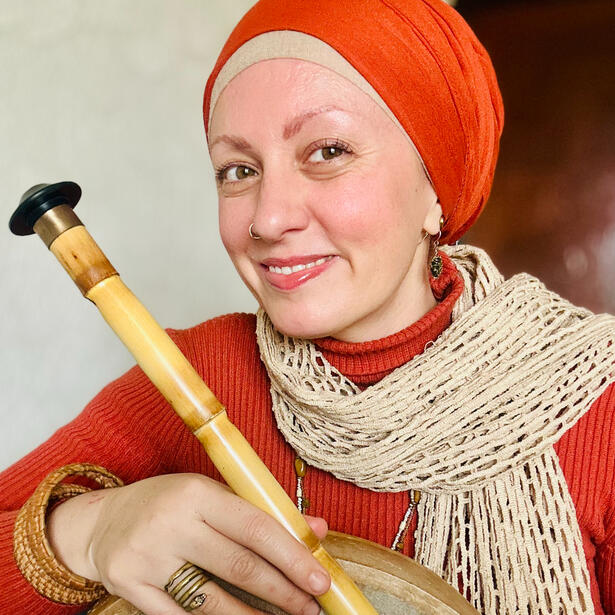
Lisa England
Writer • Musician • Independent Scholar
of Desert Devotion & Migratory Sound
Host of The Jewish Sufi Pilgrim
•
וְאִם־רָץ לִבְּךָ שׁוּב לַמָּקוֹם
"When your heart yearns,
return to the place."
- Sefer Yetzirah
•
Şeyhimin illeri, uzaktır yolları ...
"The lands of my sheikh are far,
the road is long ..."
- Yunus Emre
I follow migratory lineages of mysticism and music across the Middle East and the Silk Road.
My work explores intersections where the region’s many spiritual traditions meet through voice and instrument, influence one another, and reveal deeper continuities beneath their distinctions.
I refer to this broader field of intertwined spiritual traditions as Desert Devotion: a civilizational and spiritual landscape shaped by dry places, sacred wandering, and recurring imagery of living water in the wilderness. (Even though, of course, the religious traditions shaped by this landscape are now practiced worldwide.)Against this backdrop, I choose to work in the transmission zone where the residue of older shamanic systems and Abrahamic religiosity still overlap.In this liminal zone, I have become especially interested in traditional modal music and techniques of therapeutic sound — breath, vibration, chant, liturgy, nomadic music and Ottoman classical composition — as living archives of memory. Where dogma often hardens into boundary, sound continues to travel, carrying shared inheritance across centuries.In this sense, my role can be understood as that of an archivist of sacred sound or a cartographer of desert devotion, tracing the routes by which spiritual memory moves between traditions.At the heart of my work is a commitment to curating what I call a body of remembrance, anchored in attentive wandering. From this, I am assembling a trove of scholarship, sound, and practice that gathers shared sacred memory across traditions and passes them forward together in a way that keeps them alive.My approach is rooted in paradox, liminality, and careful listening — to texts, to music, to people, and to land. I draw not only from Jewish mystical and textual traditions, but also from the deep symbolic world of Mesopotamian goddess cosmology, especially its capacity to hold opposites without collapsing them.
Early years and prior work
Born in the American Midwest into an evangelical Christian environment, I sensed early that pilgrimage and sacred geography would shape my life. I later earned an M.A. in Linguistics from the University of Wisconsin–Milwaukee. Nearly a decade after those early beginnings, a personal rupture set me on a deeper spiritual search that led through the Arabian Gulf, into desert drumming, Eastern Christianity, Gnostic philosophy, priestess practice, and eventually into non-Zionist Judaism.Formed by Judaism’s culture of wrestling, interpretation, and fearless engagement with sacred text, I began developing my own body of work through the Temple and School of Divine Radiance, an experimental healing and teaching space I founded in 2021. There I wove together research, live ceremony, chant, and shamanic practice grounded in marginalized feminine wisdom from the Hebrew, Jewish, and Syriac Christian lineages.In this setting, I began to understand sound as one of the deepest meeting places between traditions: a space where continuity survives inside language, prayer, vibration, and music even when doctrine politicizes meaning and insists on separation.My work during this period also drew me into medieval Jewish mystical sound practices, including the vocal meditations of Abraham Abulafia and the teachings on Hebrew vowel power associated with Joseph Gikatilla — both of whom emerged from the intellectually fertile world of Muslim Iberia. These discoveries deepened my sense that devotional encounter, rather than doctrinal isolation, is often where spiritual traditions become their most creative and alive.At the same time, my research also moved further back into the ancient world, tracing intersections between early Israelite religion and Mesopotamian temple culture. This path led me to Harran in southern Türkiye: an ancient cult center of Nanna-Sîn; the biblical home of Abraham’s family before Canaan; and a site of late pagan philosophy, Islamic learning, and caravan exchange. For me, Harran is both my sacred geography and my intellectual axis — the place where the many confessional worlds of desert devotion become visible within a single landscape.Out of that devotion to place, I revived the ancient House of Rejoicing, the temple of Sîn at Harran, as a modern digital temple dedicated to writing, remembrance, and sacred sound practice. Harran remains the axis mundi of my work and the landscape to which I return on pilgrimage whenever possible.
Current projects and pursuits
Today, my work has moved forward in time into the migratory musical lineages of the Silk Road, especially the places where Jewish memory, Sufi therapeutic sound, and Central Asian traditions of healing and transmission meet.I write the Turkish Music Therapy Substack, where I document the musical, medicinal, and mystical dimensions of these lineages, particularly those transmitted through the work of Dr. Rahmi Oruç Güvenç. To enhance this project, I am working on an English translation of Oruç Baba’s Turkish-language sohbetler (spiritual and musical teachings).I also host the The Jewish Sufi Pilgrim Podcast. This podcast is a journey between the shul, the shrine, and the shaman — a joyful exploration of the shared spiritual and musical worlds among Jewish Kabbalah, Islamic Sufism, and Central Asian traditional healing. These seemingly disparate lineages met often during the medieval era on the iconic Silk Road. Their encounters still echo today.My books on sound and sacred practice include Call Back the Four Winds: Jewish Sacred Chant as a Healing Modality and Your Soul Has a Sound: Finding Your Way with the Power of Your Voice. I have also written extensively on the veiled Divine Feminine heritage within Christianity and Judaism, including Shaddai: Goddess of the Abrahamic Covenant and Magdalene Origins: Maryam Magdalene, Sacred Union, and the Temple Path of the Hebrew Qadisha.Originally from the United States, I now live in North Africa.
Lisa England is a writer, musician, and independent scholar of Desert Devotion and Migratory Sound whose work traces the intersections where the spiritual lineages of the ancient Near East and the Silk Road meet and influence one another through voice and instrument. An archivist of sacred sound and cartographer of desert devotion, she explores these connections through Jewish mysticism, Mesopotamian tradition, Sufi sound, and migratory musical lineages rooted in the sacred landscape of early Harran. She lives in North Africa.